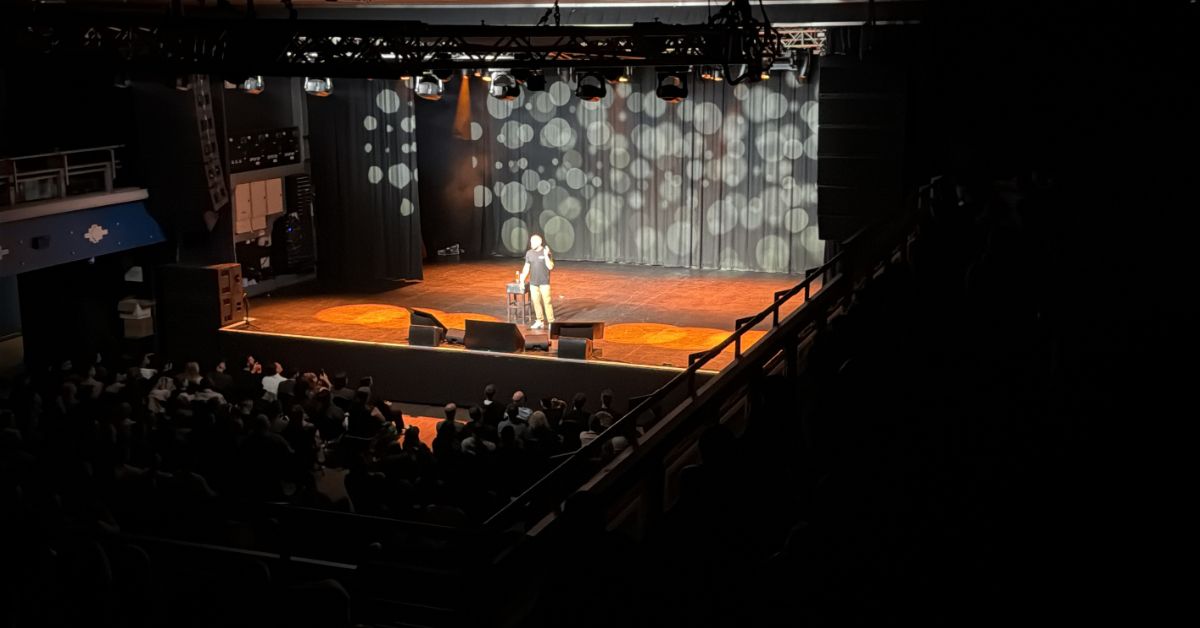
At the time of writing, I had recently attended Chris Williamson’s Mostly Wise live show, and I was super stoked. It was his first live show in the UK for around three years, so when it was announced back in February, I jumped on the tickets straight away, and I’d been waiting ever since.
When the day finally arrived, Tuesday 13th October, I set off for Birmingham’s O2 Academy, all ready and prepped for the live show experience. I arrived a number of hours beforehand to make the most of the day, and had a nice time around the city before the challenges began.
Which is the first lesson in and of itself.
Respond, Don’t React: What a Car Park Taught Me
Life is always going to throw us challenges, problems and situations to navigate. How we choose to respond, not react, is what matters.
In this situation, unfortunately, as frustration grew, I reacted a little more emotionally than, in hindsight, I would have wanted to.
As the evening drew in, I was trying to get to the car park I’d booked weeks beforehand, and I kept running into the same issue. After the fact, it seems minute. In the moment, it caused a lot of frustration and stress, because I didn’t want to be late for the start of the show, and the time was drawing ever closer.
My satnav kept taking me to the car park, but to the back entrance. No entry. No matter what I typed in, no matter what I tried, for over half an hour I just couldn’t get to the proper entrance. Brick wall after brick wall after brick wall.
It didn’t help that the evening was drawing in, I was in a city I’m not familiar with, and I don’t particularly like driving anyway. It’s one of my energy drainers. Meanwhile, the start of the show was edging closer, and I still had to find somewhere to eat before going in. The help I asked for from the locals wasn’t all that helpful.
So there I was, sat in my car, unsure what to do next.
Thankfully, after taking a moment to just breathe and come back to the present moment, I was able to find the right entrance and carry on with my evening. I didn’t want this unpleasant situation to spoil my night. Yet there was no getting away from the fact that it had changed my mental state, and I needed time to self-regulate.
Why Problems Feel Bigger in the Moment
This points to another important lesson: challenges and problems often seem bigger and more intense in the moment, when we’re actually experiencing them, than they do after the fact.
Part of self-regulation is trying to remember this as best we can, through the lens of: how will I look back on this moment a few hours from now? A day from now? Seven days from now? A month from now? You get the point. There’s research behind this, too. Looking at a stressful moment from a future point, known as temporal distancing, has been linked to less negative emotion in response to everyday stressors.
Oftentimes, we look back and wonder why we reacted the way we did, and why the situation caused us so much angst, distress or frustration, or whatever we felt in the moment.
This isn’t to beat ourselves up. It’s an opportunity to learn and grow.
Emotions Are Feedback, Not the Truth
Remember, all emotions and feelings are feedback tools. While they’re not the truth, they are insightful. It’s something I’ve explored before in how to stop reacting to every feeling.
Our Perspective Determines Our Reality
Finally, I got to the O2 Academy just as the show was about to begin. I had to stand, as I couldn’t find any available seating. James Smith opened the show before welcoming Chris himself onto the stage about 15 to 20 minutes later.
The live show itself wasn’t what I was expecting, which points to another fundamental truth: it’s our perspective that determines our reality.
In fact, my entire experience, of travelling to the live event and of the event itself, is summarised by this lesson that I keep coming back to. Our perspective determines our reality. And our perspective is made up of our thoughts, feelings, life experiences, belief systems, mindset, values and principles. Basically, everything that comes together to shape how we see the world and approach life.”
How Our State Shapes the Way We Respond
Take my car parking situation. Half an hour of going around a one-way system, going nowhere, caused me a lot of frustration and distress. Another person might have remained completely calm and composed.
How each of us reacts or responds to a situation differs based on our perspective and how we see life. But it also varies with how we’re feeling, and what our overall state is on the day.
The best example of this is sleep deprivation. In that state, we’re much more likely to react to something that, after the event, seems small and insignificant, compared with when we’ve had a great night’s sleep and are feeling on top of the world. Research on sleep loss found that after a single night without sleep, the brain starts to treat even neutral things as more emotionally charged.
My energy was dragging after the travel, especially the driving, which I find energy-draining in and of itself. Still, there’s no getting away from the fact that I could have responded more consciously and differently. That’s something I’m taking away and learning from the whole experience.
No Expectations: Expect Nothing, Appreciate Everything
Back to the evening. It wasn’t as I expected, which points to the idea that our expectations can greatly influence how we feel.
That’s why I keep coming back to approaching life with a no-expectations mindset, one of openness and gratitude. Expect nothing; accept and appreciate everything.
Our minds can easily fall into making predictions, forecasting, and thinking about how something might be, especially for us overthinkers and ruminators. It takes conscious effort and mindfulness to let these thoughts go, without holding on to them so tightly. In my experience, that helps us live more peacefully. Which, for me at least, is part of the ultimate goal: to be at peace and content within ourselves.
Finding the Lesson in Disappointment
There are a few reasons why the live show wasn’t what I expected. And yes, I was disappointed. As I mentioned, I’d been so excited, so stoked for it, for most of the year. So to leave feeling slightly disappointed was unfortunate and, in a weird way, disappointing in and of itself.
But I’m also glad I attended. Not everything is going to play out the way we thought, or be entirely enjoyable. Life doesn’t operate like that, and that’s okay. The experience is still the experience, one with its own lessons and insights that I can learn and grow from. The same is true of any experience any of us go through.
Whether pleasant and enjoyable or unpleasant and disappointing, all experiences are part of life, and it’s up to us to take from them what we will. Hopefully, learning and growing through them as part of the process. Coming back, once again, to the repeating theme: our perspective determines our reality.
I’m also glad I went because now I can tick it off my bucket list, the list of experiences, events and things I want to do, and start to plan and move on to the next.
There’s also the recognition that the disappointment resides in my expectations. With different expectations, or by adopting more of a no-expectations mindset, my overall perspective of the live show would have been completely different. And other people in the room could have, and most likely did, experience a completely different event.
So the live show wasn’t a waste of time. Not only because I learned more about myself and had some things reiterated from travelling to the show and navigating the challenges around it. But because Chris, as always, shared some profound wisdom, just as he does on his podcast, Modern Wisdom. Putting the jokes, sly remarks and digs to one side (which I get; they help create a bond with the audience and spice things up but aren’t my thing), here are the top lessons I’m taking away.
10 Lessons from Chris Williamson’s Mostly Wise Live Show
1. Just because you’re invested in something doesn’t mean you have to stay
Say you hate your job, and someone asks you, “Why don’t you leave?” Your response: “Because I’ve been here for three to five years.”
Is that a reason to stay? Just because you’ve been there so long, just because you’re invested in it, even though you hate it?
My takeaway was no. We’re not trees. We can always move. Just because we’ve invested time into something, if it’s now causing us more distress, unease and unhappiness, if the costs aren’t worth paying any more, then maybe moving, whatever that looks like, is the best thing we could do.
2. You could just be in the wrong place
The example Chris gave was how, once he moved from the UK to the States, his podcast blew up.
It highlighted that we could be doing everything right, on the right path, and still not be reaching the level of our potential. By moving towns, cities, maybe even countries, things can change for the better.
It may even be in the smaller things, like changing our job or changing departments. By making some sort of change, our life changes. We’re no longer in the wrong place. We’ve found where we’re meant to be.
To me, this shows there might not be anything inherently wrong. We may just need to make a few simple changes to change the trajectory of our lives.
3. Give yourself better problems to solve
For some of us, fixing problems is what we do. It’s like our minds default to identifying problems where other people think no problem resides. We’re super sensitive, super heightened to them, and will invent them if there isn’t actually a problem to solve.
This isn’t inherently good or bad. But if this is your disposition, wouldn’t it be better, maybe even healthier, to give yourself problems worth solving? Rather than ones that aren’t that meaningful and don’t result in any change.
4. People often criticise what they’re afraid to do themselves
It highlights their own insecurities. You start a podcast and get ridiculed by friends and family. You change jobs, and your parents don’t approve.
Oftentimes, especially with parents and family, they do care and are looking out for us. But some of the criticism and negativity is also because, when they were your age, they may not have had the courage to do something similar, and now regret it. Seeing you take the leap of faith and display the courage to pursue your goals, dreams and desires triggers something deep within them that they wish they had done.
This isn’t a reason to stop pursuing your goals and dreams. It’s something to be aware of, so you can show empathy and compassion towards those around you, and continue on your own journey and path.
5. Doing what everyone else does feels safe, but it’s often the worst decision
Somewhat related to the previous lesson: it often feels safe to do what everyone else is doing, but it’s often the worst decision, because most people aren’t living their best life. Most people aren’t living the life they actually want to live, or being the person they actually want to be.
Chris referenced a stat that the average American is overweight, in debt and deeply unhappy. Basically, don’t do what everyone else is doing just because it feels safe. Follow and pursue your own path, even though it can often feel scary.
6. You’re way less alone than you think you are
Again, somewhat related. Oftentimes we don’t pursue our own path because we’re fearful of being ridiculed by those around us, and find it hard to find people on a similar trajectory to us.
Chris often refers to the gap between leaving your old social group and finding your new tribe as the lonely chapter. At the time of writing, it feels like I’ve been there for my entire young adult life, so this one resonates deeply.
However, standing in the O2 Academy, I realised that all of these people, in some shape or form, are invested in their personal growth, maybe even interested in business and entrepreneurship. Otherwise, why would they attend such an event? Let’s even say half the room got dragged there by their spouse. That would still leave half the room interested and invested in their personal growth and unfoldment.
While it often feels like we’re navigating life alone, our tribe, our people, are out there. Finding them, connecting with them and forming friendships and relationships with them is obviously the hard part. It requires us to get out there and start living life more intently.
We’re less alone than we think we are, and knowing that helps us open ourselves up to connecting with others.
7. Fully living your life means actually feeling what happens
Do you truly feel your feelings? Chris shared how, particularly for men, this is a challenging one. And I agree.
I’ve written a lot about emotions and feelings. Not only are they our felt experience of the world, and therefore matter, but they’re also feedback tools to learn and grow from. To cut ourselves off from the wide range of our emotional landscape is to cut off a bit of what it means to be human, and therefore from experiencing life fully.
Our emotions and feelings matter. For most of us, especially us guys, I’d recommend going, as Chris would say, below the neck, to truly feel them on a deeper level and enrich our life experience. Yes, that means the uncomfortable ones too.
8. Adversity is a terrible thing to waste
It can easily become growth. Most of us shy away from adversity because we think it’s bad, and it feels unpleasant. But oftentimes, our adversity is what leads to our biggest breakthroughs.
The proof is in the pudding when we think back to the signature moments that have propelled our personal growth up to this point in our lives. Take a moment to think about what those moments are for you: the adversity you found yourself in, how it propelled your growth and evolution, and how it made you stronger, into the person you are today.
Keep this in mind the next time you face adversity. Don’t shy away from it. Step into it, and allow it to propel your next unfoldment.
9. It’s never too late to totally reinvent yourself
Adversity can propel us to do this. Yet at the same time, why would we wait for adversity, challenges and problems to occur when we can take the first step ourselves?
Adversity, challenges and problems are an inevitable part of life. Yet we have agency. If we’re not happy with where we are, we don’t have to wait for bad things to happen to reinvent who we are. We can start today.
Oftentimes, that’s just by making one small positive change in the direction of the person we want to become. Waking up 15 minutes earlier. Saying no to the fast-food restaurant, or buying that gym membership.
Any step in the right direction is a step in the right direction, no matter how small or insignificant it may seem.
Bottom line: we don’t need to wait for adversity to reinvent ourselves or our lives. We have agency. We have the choice to do that ourselves. (If you want a framework for taking that first step on purpose, I’ve written about how to create your life by design.)
10. Whatever it is you want to do, do it anyway
Want to start a podcast, but feel the market’s oversaturated, that people won’t listen, that your brother will laugh at you? Do it anyway.
Want to take up a new sport, but don’t know where to begin, and would rather do it with someone, a loved one, because it’s new? Do it anyway.
Want to change careers or switch jobs, but feel you’ll be ridiculed by the people around you? Do it anyway.
Whatever you want to do, do it anyway.
Life Is Temporary, So Do It Anyway, Today
Chris ended the live show by telling the story of someone who did just this. Despite a hugely successful career, he gave it up to spend more time with his family, with his kids, because that’s what he wanted to do. He ended up passing away in his 50s.
Had he waited until retirement, had he not done what he wanted to do and spent more time with his kids in his 30s and 40s, he would never have been able to in his 60s and 70s.
That’s the big thing for me here. To do the things, pursue the goals and create the life we want, despite any backlash we may receive from those around us. That backlash will only be temporary in and of itself, because life is temporary, and we don’t know what tomorrow might bring.
So we might as well do it anyway. Whatever it is for us. Today.
Key Takeaways for Lessons from Chris Williamson’s Mostly Wise Live Show
- Respond, not react: Life will always throw challenges at us. How we choose to respond to them, rather than react, is what matters.
- The future lens: Problems feel bigger in the moment. Ask how you will see this moment in a few hours, a day, seven days or a month.
- Emotions are feedback: Feelings are not the truth, but they are insightful. Use them to learn and grow rather than to beat yourself up.
- Perspective shapes reality: Your thoughts, beliefs, values and current state, including how well you slept, shape how you respond to the same situation.
- No expectations: Disappointment lives in our expectations. Expect nothing, accept and appreciate everything, and let go of forecasting how things will be.
- Sunk time is not a reason: Three to five years in a job you hate is not a reason to stay. If the costs are no longer worth paying, moving may be the best option.
- The lonely chapter: The gap between leaving an old social group and finding your new tribe can feel lonely, but you are far less alone than you think.
- Start reinventing today: You do not need adversity to change. One small step, like going to bed 15 minutes earlier, is a step in the right direction.
FAQs for Lessons from Chris Williamson’s Mostly Wise Live Show
How do you respond instead of react when you’re stressed?
Pause, breathe and come back to the present moment before acting. That short reset gives you room to choose your response. It also helps to ask how you will see the situation in a few hours, a day or a month, because problems usually feel bigger in the moment than they really are.
Why do problems feel bigger in the moment?
Problems feel bigger in the moment because your emotions and current state amplify them. Tiredness, low energy or an unfamiliar place can make small obstacles feel intense. Looking back hours or days later, most of us wonder why we reacted so strongly. Emotions are feedback worth learning from, not the truth about the situation.
How do expectations affect disappointment?
Disappointment usually lives in the gap between what you expected and what actually happened. The more you build something up, the more room there is to feel let down. A no-expectations mindset, expecting nothing while accepting and appreciating everything, lets you meet an experience with openness rather than measuring it against a prediction.
Should you stay in a job just because you’ve been there for years?
No, time invested is not a reason to stay on its own. If you hate your job and the only reason to remain is the three to five years you have already put in, ask whether the costs are still worth paying. If they are not, moving may be the best thing you can do.
What is the lonely chapter?
The lonely chapter is Chris Williamson’s term for the gap between leaving your old social group and finding your new tribe. It can feel isolating and last longer than you would like. You are less alone than you think: people invested in their own growth are out there, and finding them means getting out and living more intently.
Is it ever too late to reinvent yourself?
No, it is never too late to reinvent yourself, and you do not need to wait for adversity to start. Begin with one small change towards the person you want to become, such as going to bed 15 minutes earlier, saying no to fast food or buying a gym membership. Every small step counts.