To feel like a failure often means we believe we’re not good enough…
Incapable. Inadequate. Insignificant. Less than. Not enough.
What Does Feeling Like a Failure Actually Mean
What does all this mean for navigating life?
It often means that whenever we don’t meet a certain standard, an expectation, a goal, an objective, or a milestone, we don’t only take it personally, like it’s a mark against our character and who we are as human beings, we stop striving.
We question what’s the point of striving or even trying if we always end up failing and end up feeling the lowest depths of despair, despite maybe actually being a rather ambitious person with high hopes, dreams and goals for ourselves, wanting to make something of our lives while we can, while we’re here.
Where The “Not Good Enough” Belief Comes From
Often, the sense of not being good enough goes back to our earliest days. Yes, throughout childhood, and also our teenage years, a key part of our development.
The more I learn about the human condition, the more I realise our earliest context is so important for who we turn out to be and the behaviours, habits and patterns we bring into adulthood.
That’s not to say they can’t be changed, but my God, it’s not easy or straightforward.
The good news, alongside that, through self-work, which can take many different shapes and forms, is that we all, in some disguise, have issues, trauma or insecurities that are holding us back from who we truly are and our becoming.
The sense of not being good enough is a big one. It’s one that many of us face.
The Early Messages That Shaped Us
Maybe a parent or caregiver unintentionally told us this, directly or indirectly, as they were constantly stressed, which, through no fault of your own, we felt the full burden of.
Or maybe it was a teacher or sports coach, or anyone in our life who we used to, and maybe still do, look up to and admire.
It could have just as easily been our so-called friends and the social groups we were around, where we felt that we never truly fitted in. Maybe they teased us for the colour of our hair or skin, or because we were perceived differently in some way, whatever the reason.
The thing is, it’s never usually just one thing. But a multiple.
Research on adverse childhood experiences consistently shows the lasting impact these early environments have on adult self-worth. And it resulted in developing the belief that we’re not good enough, you’re not good enough, which, unconsciously to this day, shapes the direction of our lives.
How Limiting Beliefs Quietly Run The Show
We have many of these beliefs because that’s what beliefs are. The invisible, hidden narratives, much like our default thoughts, that are playing away in our subconscious mind, shaping and directing the course of our lives.
Oftentimes, it feels like we’re a victim to said beliefs, like there’s nothing we can do. They’re running the show. But despite this, which is a belief in itself, we are wrong.
We can reprogram our beliefs to be more empowering than we may even believe possible, to support the life we want to live, propel our personal growth, and help us in our true becoming, the journey of becoming who we truly are and want to be.
As stated, it does require work, self-work and conscious personal growth, which is the conscious art and practice of improving oneself and becoming more of who we truly are, undoing a lot of the beliefs, patterns, self-narratives and habits formed throughout our lives as safety and survival mechanisms.
Every Belief Was Once a Survival Mechanism
Because here’s the thing…
All beliefs, behaviours, patterns, habits, and traits we’ve developed, even the unhelpful, unhealthy, and unpleasant ones, are adaptations that we’ve formed to ensure our safety and survival; in other words, our existence.
Sure, today, they may not serve us in the way we want. Many don’t, but once upon a time, they did.
For example, the belief “not good enough” may have protected you from experiencing emotional pain, failure, or being open and vulnerable, which, years ago, was your body’s way of protecting you, and the exact survival mechanism needed.
The problem is when that becomes our identity, who we believe we are, and starts to dictate our life in unhelpful, if not damaging, ways.
The Path Forward: Awareness, Openness, and Self-Work
Awareness is often the first step. Starting to become aware of the beliefs, patterns and hidden narratives that are running the show, dictating our lives in the background.
Then comes openness, the openness to change them. Often, through asking for help or an intervention that is different to what we would usually do, because we have to break the pattern.
If we always do what we’ve always done, we will always get what we’ve always got.
And that’s the hard truth of the matter.
This in itself can be an uncomfortable truth for many to accept. Without acceptance, though, we will just remain where we are, victims of our own beliefs that, while we may have developed, were done so unconsciously, unintentionally, and as adaptations to our circumstances at the time.
Through awareness and openness, we start to bring the unconscious conscious, the first step in forming new, empowering, helpful beliefs and behavioural change.
And get this:
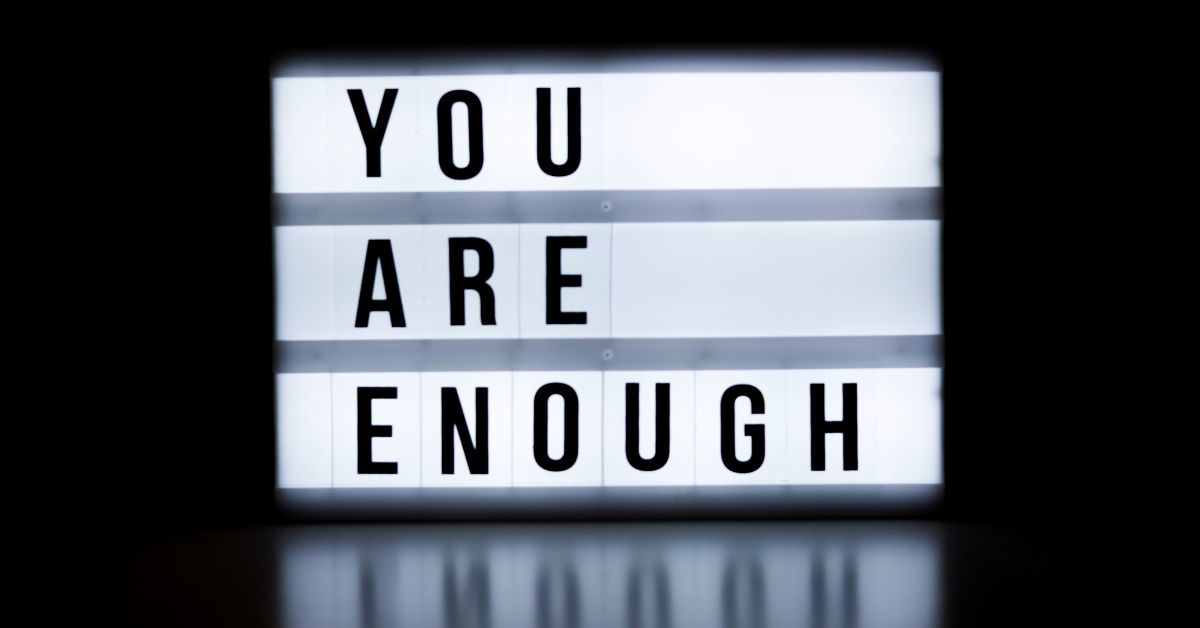
We are enough. You are enough. As we are. As you are.
You Are Already Enough, Here’s What That Really Means
Without having to do anything, get anything, please anyone, or show up in the world in any particular way.
We forget this. I know that I do.
Not on our good days, when it’s easy to remember, when things are going well, to plan, when we feel like we’re making progress, striving forward, and are living meaningfully and intentionally.
But on the days when we begin to feel like a failure all over again. And all those unpleasant feelings come rushing back, incapable, inadequate, not enough.
This is the time to remember that we are enough as we are.
That doesn’t mean we don’t engage in personal growth and become active participants in our unfolding and becoming; these are innate parts of who we are.
We are designed to grow. Although it doesn’t happen by default.
All forms of self-work and personal growth require conscious effort. Meaning that we engage in them, not as a mechanism or way to fill some void or gap so that we can feel good enough, because we are already enough as we are, but as an active, conscious participant in our becoming, so that we undo a lot of the unconscious beliefs, behaviours and hidden patterns running in the background to enjoy and make the most of the precious gift that we’ve been given, life itself.
Remember:
We all have beliefs, hidden self-narratives and behavioural patterns running the show, often in the background, often ones we’re consciously unaware of.
One of those beliefs, a common one, is that we, you, are not enough.
It is false. Not true. A lie.
We are enough. You are enough, just as you are.
And the art and practice of all self-work is realising that for yourself.
Then, beginning the journey of undoing a lot of those beliefs and hidden patterns that once served you as a protection mechanism, but no longer do.
We are enough. You are enough.
Use that as the foundation of your unfolding and becoming more of who you truly are.
The Key Takeaways on Overcoming the Feeling of Not Being Good Enough
- Your Inherent Worth: The core message is that you are already enough, just as you are. Personal growth isn’t about fixing a deficit; it’s about removing the old beliefs that prevent you from realising your intrinsic value.
- Understanding the Feeling: Recognise that feeling like a failure often comes from not meeting specific expectations. This can lead you to stop striving, even when you have ambitious goals for your life.
- Childhood Origins: Your belief of not being good enough frequently stems from early life experiences. Messages from parents, teachers, or social groups during your formative years can unconsciously shape your adult self-worth.
- The Role of Limiting Beliefs: These are hidden narratives that quietly guide your actions. The good news is that through conscious self-work, you can reprogram these beliefs to support the life you want to live.
- Beliefs as Survival Tools: Understand that even a harmful belief like “I’m not good enough” likely started as a way to protect you from emotional pain or vulnerability. The problem is when this old defence mechanism starts to limit your present life.
- The Path to Change: The journey forward begins with awareness of these hidden patterns. This is followed by an openness to change, which requires breaking old habits and accepting that a new approach is needed.
FAQs for You Are Enough: Overcoming the Feeling You’re Not Good Enough
Why do I feel like a failure even when I have big goals?
This is a common conflict. The feeling of failure often arises when you don’t meet a specific standard you’ve set for yourself. This single event can trigger a deeper, underlying belief that you aren’t good enough, causing you to question the point of even trying, despite your ambitions.
Can I really change a belief I’ve had since I was a child?
Yes, you absolutely can. While it requires conscious effort and self-work, it is possible to reprogram these deep-seated beliefs. The first step is becoming aware of them. From there, you can begin the process of undoing old patterns and forming new, empowering narratives that serve you better today.
What is the most important first step to feeling good enough?
Awareness is the crucial first step. You need to start noticing the hidden thoughts and beliefs that are running in the background. Once you become conscious of the “not good enough” narrative, you can begin to challenge it and open yourself up to the possibility of change.
If I’m already enough, why do I need to work on myself?
That’s a great question. Self-work isn’t about *becoming* enough, it’s about *realising* you already are. The work involves undoing the unhelpful patterns and beliefs that obscure this truth, allowing you to live more freely and fully as your authentic self.
How could a negative belief have ever been helpful?
Beliefs, even negative ones, often form as protection. For example, believing you’re “not good enough” might have protected you from the pain of rejection or failure as a child by preventing you from taking risks. It was a survival mechanism that, while no longer useful, served a purpose at one time.